

A cover letter is a one-page letter that tells an employer why you fit this specific job. Open with the role you’re applying for, give two achievements that match the job ad, and close with a clear next step. StylingCV is an online CV builder with Arabic and English templates and a free ATS check.
What a cover letter template should contain
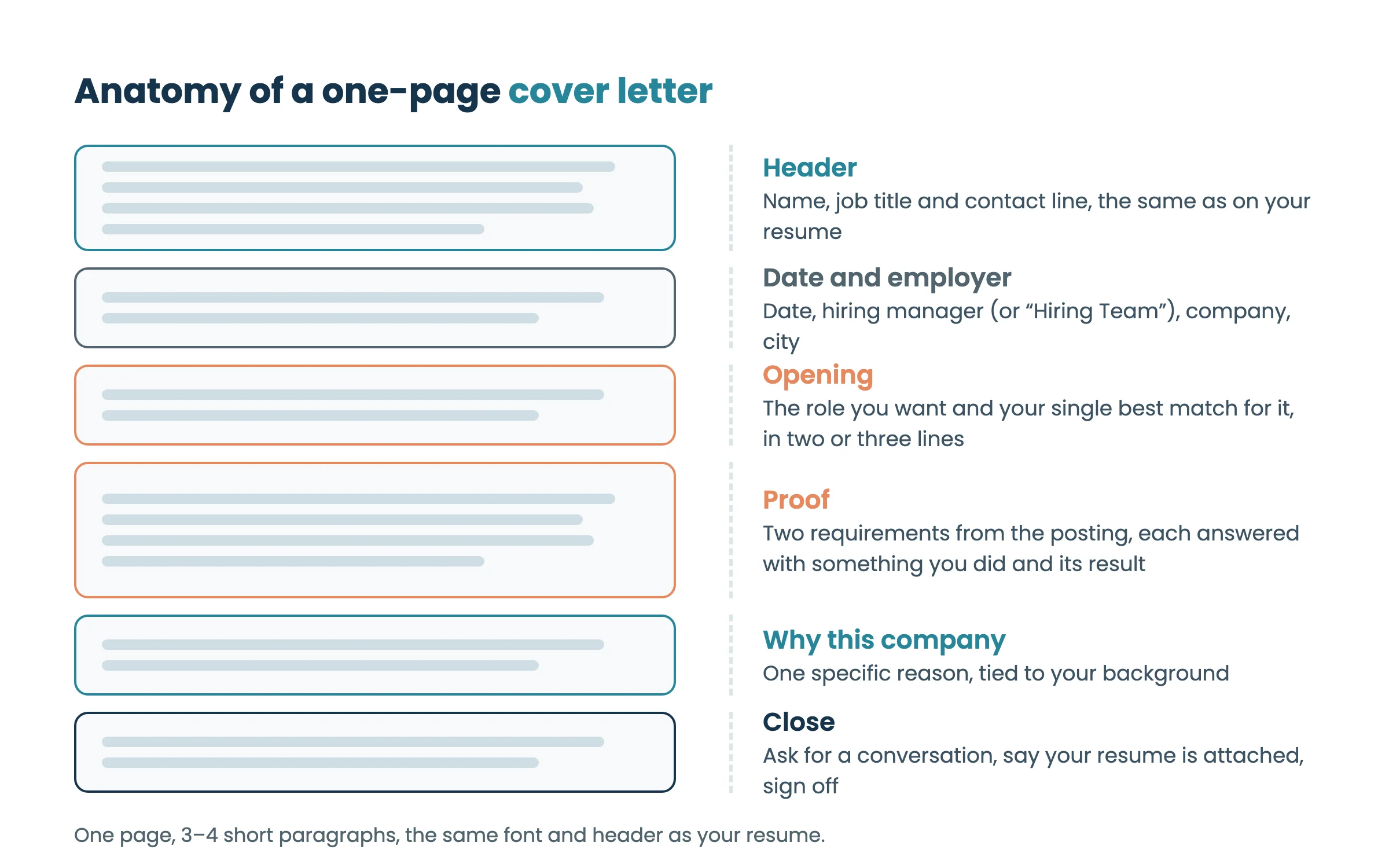
A cover letter template is a skeleton, not a script. Three parts do all the work, and each one answers a question a recruiter is already asking.
The role and why you. The first two lines name the exact job title from the ad and where you saw it. That tells the reader the letter is for them, not a mail merge.
Two achievements that match the ad. Pick the two requirements the ad repeats or puts first, and answer each with one result you can point to — a number, a deadline, a saved cost, a satisfied client. Two is enough. Five reads as a list and gets skimmed.
A specific next step. Close with the outcome you want: an interview, a conversation, a portfolio review. Say when you are available and how long your notice period is.
Everything else — the greeting, the sign-off, the address block — is furniture. A good template gets the furniture out of the way so the three real parts are easy to write.
A cover letter template you can copy and fill
Fill the brackets, delete any line that does not apply, and keep the whole thing to one page. Keep the job title exactly as the ad writes it.
[Your name]
[City, country] · [email] · [phone] · [portfolio or LinkedIn, optional]

[Date]

[Hiring manager's name, or "Hiring team"]
[Company]
[Company address, optional]

Dear [Hiring manager's name / Hiring team],

I am applying for the [exact job title from the ad] role at [company], advertised on [where you saw it] on [date].

In my current role as [role] at [employer], I [result matching requirement 1 — verb + number]. I also [result matching requirement 2 — verb + number]. [One sentence tying both results to what the ad says the team needs, naming a product, market, project or client at the company you can actually point to.]

I would welcome the chance to discuss how I can [the outcome named in the ad] in this role. I am available for an interview on [days/times], and I can start [notice period].

Sincerely,
[Your name]
Three practical rules for filling it:
- One page and three body paragraphs, roughly 250–400 words. Longer letters get skimmed. The one accepted exception is a career change, where the reason for the move may stand alone as one short extra paragraph.
- Every bracket gets replaced. A live
[company]is worse than no letter. - The achievement sentences change for every application. The structure stays; the two results are rewritten against each ad.
How to fill in the template, paragraph by paragraph
Keep the job posting open while you write: the letter shows the employer that you read it and can do what it asks. This order is faster than writing from the top down:
Take them word for word, for example “experience with warehouse KPIs” or “Power BI”. These decide what goes in the proof paragraph.
One example per requirement, with what changed because of it: a number, a deadline met, a process that now runs differently. That becomes the proof paragraph.
A product, an expansion, a project in the news, a value on their careers page. Name one concrete reason and skip the general praise.
Once the proof is written, you know your strongest match. Put it in the first two lines, next to the job title.
Check the company name, the job title and the hiring manager’s name, and cut anything that doesn’t serve one of the three requirements.
Worked cover letter examples
The three letters below use invented figures and describe their employers rather than naming them, so none of them can match a real company. They are here to show structure and tone — copy the shape, not the content.
Fresh graduate with no experience
With no job history, the evidence comes from coursework, an unpaid project or volunteering. Name the task, the result and what it proves.
Lina Haddad
Dubai, United Arab Emirates · lina.haddad@example.com · +971 5X XXX XXXX14 March 2026
Hiring Team
A mid-size retail group in DubaiDear Hiring Team,
I am applying for the Marketing Assistant role at your company, advertised on your careers page on 9 March.
During my final-year marketing project at university, I planned and ran a three-week social campaign for a campus café with a team of four. We grew the café’s Instagram following from 180 to 640 followers and filled 35 seats at its opening event. I also wrote and scheduled the campaign’s 18 posts myself, which is the day-to-day work your ad describes. Your ad mentions two new store openings this year, and that project taught me how much local, store-level content matters when a brand opens somewhere new.
I would welcome the chance to discuss how I can support the opening campaigns in this role. I am available for an interview any weekday afternoon and can start immediately.
Sincerely,
Lina Haddad
Why it works: every claim is something a graduate could actually have done, and the two results sit in the same paragraph as the company sentence — the shape the template asks for.
Career change
The bridge paragraph is the whole letter. Do not apologise for the change — show that the old job produced a skill the new job needs.
Omar Nasser
Amman, Jordan · omar.nasser@example.com · +962 7X XXX XXXX14 March 2026
Hiring Team
A data analytics consultancy in AmmanDear Hiring Team,
I am applying for the Junior Data Analyst role at your consultancy, advertised on LinkedIn on 6 March.
For seven years I worked as a civil engineer on infrastructure projects, where my main job was turning site measurements into decisions. On the last project I rebuilt the progress-tracking spreadsheet into a dashboard that flagged delays four days earlier than the old weekly report, and the site team used it to recover eleven working days across the schedule. Alongside that role I completed a six-month data analytics course and now work daily in SQL and Power BI.
I am moving into analysis because the part of engineering I kept volunteering for was the measurement and reporting, not the site work. Your focus on construction and logistics clients is the exact overlap I want: I understand the site data and I can now model it.
I would welcome the chance to discuss how that combination fits your team. I am available for an interview after 5 pm on weekdays and can start after a one-month notice period.
Sincerely,
Omar Nasser
Why it works: the transferable skill is named in the first line and proved with one measured result — and this is the one letter that keeps a fourth paragraph, the stated career-change exception.
Saudi / Gulf application written in English
When the ad and the portal are in English, write in English even if the office speaks Arabic. Keep it to one page, use the employer’s own job title word for word, and leave out the personal details that do not belong in a letter — no photo, no marital status, no nationality or date-of-birth line. If you already live in the country and your residency status allows you to move employers, one factual line about availability can save a round of questions; if you are applying from abroad, say plainly when you could relocate.
The letter usually travels with a CV, and the Gulf CV layouts page covers the one-page format to pair it with.
Noura Al-Harbi
Jeddah, Saudi Arabia · noura.alharbi@example.com · +966 5X XXX XXXX14 March 2026
Hiring Team
A logistics company in JeddahDear Hiring Team,
I am applying for the HR Coordinator position at your company, advertised on the company website on 8 March.
In my current role as HR Coordinator at a Jeddah freight forwarder, I manage onboarding for about 40 new hires a year across three branches. I rebuilt the onboarding checklist into a single tracked form that cut the average time from offer to first day from nine days to five, and I introduced a monthly Arabic and English induction session that new hires now attend in their first week. Both are the responsibilities listed in your ad, and they matter most during an expansion like the two new distribution hubs your posting describes.
I would welcome the chance to discuss the role. I am available for an interview at your convenience and can start after a 30-day notice period.
Sincerely,
Noura Al-Harbi
Why it works: the letter is in English because the ad and portal are; the job title is copied exactly; the two results answer the ad’s two duties; and the personal-status material that does not belong in a letter is simply absent.
What not to repeat from your CV
The CV already lists what you did. The letter carries why it matters for this job. Three things to keep out:
- The full work history. No reverse-chronological list of every role. Two achievements from the most relevant role beat a summary of ten years.
- A skills dump. “MS Office, communication, teamwork, time management” tells a recruiter nothing they cannot read in the CV. Replace it with one sentence showing a skill in use.
- A copy of your CV summary. If the first paragraph of the letter could sit unchanged at the top of the CV, it is doing neither job. The letter names the role and the company; the summary cannot.
If you are also rebuilding the CV that goes with the letter, the CV templates page shows the layout side, and the Saudi Arabia resume builder page covers the local conventions — those two pages are where history and skills belong.
FAQ
How long should a cover letter be?
One page, three to four paragraphs, roughly 250–400 words. Longer letters get skimmed, not read.
Can I use the same cover letter for every application?
No. Reuse the structure, rewrite the two achievement sentences so they answer that job ad. A generic letter is the most common reason a shortlist stops at the CV.
Do I need a cover letter if the job ad doesn’t ask for one?
Not always, but when the ad is silent a short, specific letter is still read. Keep it to one page and name the role in the first line.
Should the letter be in English or Arabic for a Saudi employer?
Match the language of the job ad and the application portal. If the ad is in English, write in English even when the office speaks Arabic; if the portal is Arabic, use the Arabic version.
What should I not repeat from my CV?
The duties list and the skills section. The letter carries why those duties make you the fit for this role, and one concrete result the CV only lists.
Cover letter guides for specific jobs
A template gives you the structure. For full annotated letters, start with the cover letter examples hub, or open the guide for your job:
- Sales cover letter guide
- Accountant cover letter guide
- HR cover letter guide
- Software engineer cover letter guide
- Housekeeper cover letter guide
- Nanny cover letter guide
Send a resume that matches your letter
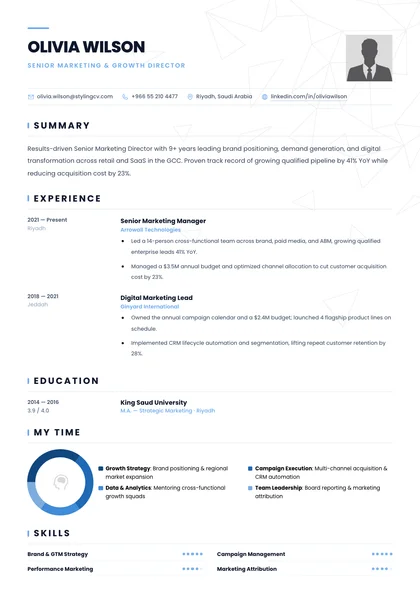
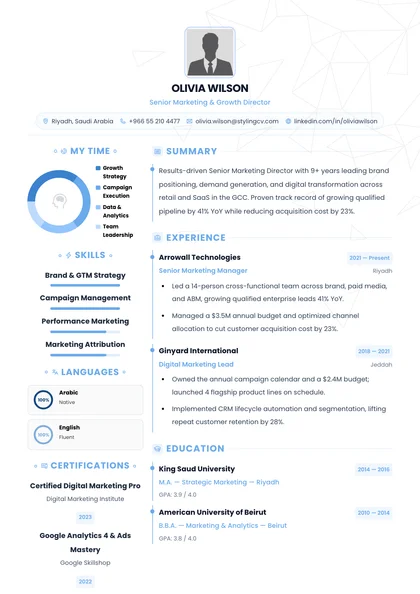
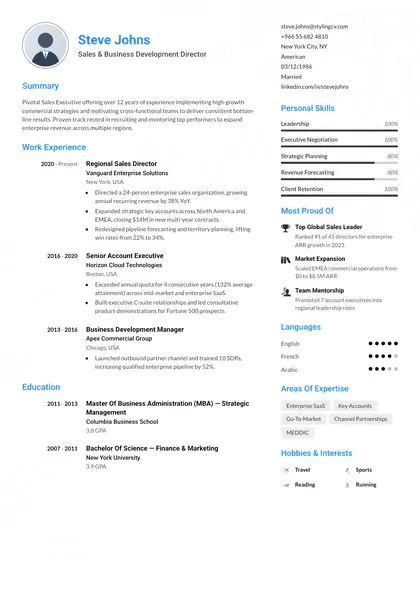
114+ resume templates in English and Arabic. Pick one, fill it in the builder, and check how it matches the job before you send it.
Sources
- UCLA Career Center: Cover letter template
- University of Michigan Career Center: Cover letter resources (length, paragraphs, font)


