What should a CNA cover letter include?
A CNA cover letter should name your certification state and registry status, the care setting you know, and one example of daily care you handled well. Add your shift availability and keep every resident detail out. Use the samples below as models, then create your own letter in the StylingCV app.
Go to three full letters, how to state your registry status, writing with no experience or what to leave out.
Three CNA cover letter examples
Choose the sample closest to your situation. Every person, facility and figure here is invented, so swap in your own state, setting and record.
Example 1: Experienced long-term care CNA
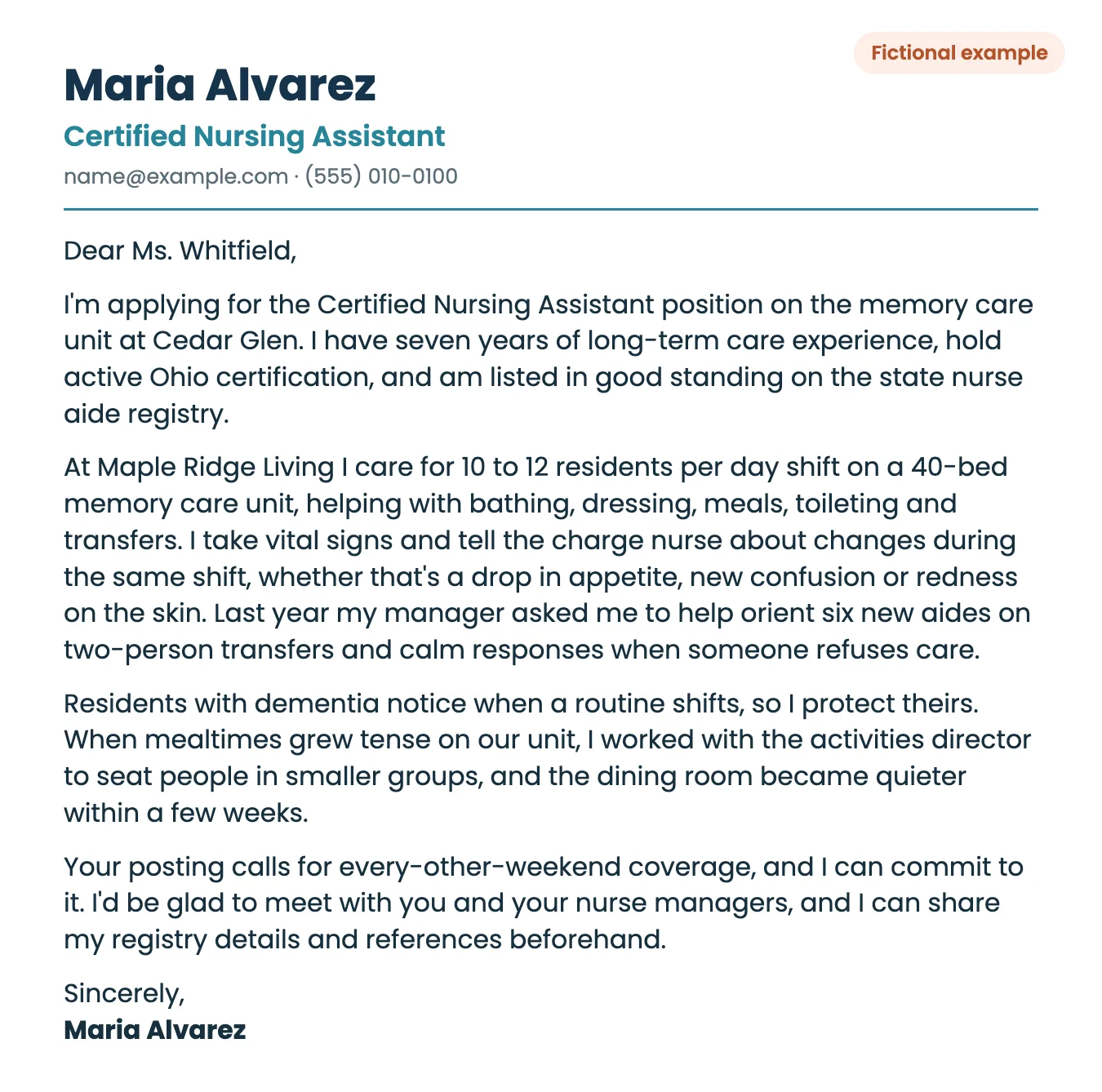
Dear Ms. Whitfield,
I'm applying for the Certified Nursing Assistant position on the memory care unit at Cedar Glen. I have seven years of long-term care experience, hold active Ohio certification, and am listed in good standing on the state nurse aide registry.
At Maple Ridge Living I care for 10 to 12 residents per day shift on a 40-bed memory care unit, helping with bathing, dressing, meals, toileting and transfers. I take vital signs and tell the charge nurse about changes during the same shift, whether that's a drop in appetite, new confusion or redness on the skin. Last year my manager asked me to help orient six new aides on two-person transfers and calm responses when someone refuses care.
Residents with dementia notice when a routine shifts, so I protect theirs. When mealtimes grew tense on our unit, I worked with the activities director to seat people in smaller groups, and the dining room became quieter within a few weeks.
Your posting calls for every-other-weekend coverage, and I can commit to it. I'd be glad to meet with you and your nurse managers, and I can share my registry details and references beforehand.
Sincerely,
Maria Alvarez
Example 2: New CNA after state exam and clinicals
Dear Mr. Okafor,
I'm applying for the entry-level CNA opening at Lakeview Rehabilitation. I finished the state-approved nurse aide program at Tri-County Community College in September, passed the written exam and skills evaluation in October, and now appear on the Pennsylvania nurse aide registry.
During 48 hours of supervised clinicals at Brookside Manor, I helped residents with feeding, repositioning, hygiene and walking with a gait belt. I learned to knock, introduce myself, explain each step and close the curtain before starting care. I also learned to ask what a resident could still do alone, then leave that task to them. My RN instructor checked my vital signs against her own during the rotation, and I brought anything unusual to the assigned nurse right away.
Before the program, I spent two years helping my grandfather at home with meals and getting in and out of his chair. That time showed me how physical this work is and how much patience a slow morning takes.
I can work days, evenings or weekends. Your preceptor-led orientation is why I'm applying to Lakeview first, and I'd welcome the chance to meet and talk about your new aides' first month.
Sincerely,
Tasha Mitchell
Example 3: Moving to home health or a hospital
Dear Ms. Nguyen,
I'm applying for the Home Health Aide position with HomeBridge Health. After five years as a CNA at Riverside Nursing Center, I want to give one-on-one care in clients' homes. My Michigan certification is active, and I'm listed in good standing on the state nurse aide registry.
On a 30-bed rehabilitation hall, I assist with bathing, dressing, transfers and walker use, take vital signs, follow each care plan and finish my charting in PointClickCare before the shift ends. That routine carries directly into home visits, where the plan and the notes are often the main link between you and the aide.
Home care asks for more independence, and my current role has prepared me for it. For the past year I've been our float aide across three halls, so I'm used to stepping into an unfamiliar routine, reading the plan quickly and calling the nurse when something looks different.
I have a reliable car and can cover clients within 25 miles of Lansing. Could we talk this week about your caseload and how your RN supervisors support aides in the field?
Sincerely,
Denise Carter
Keep resident and patient details out of your letter
Leave out anything that could point to a specific person. Under HIPAA, protected health information covers health or care details that identify someone or could reasonably identify them, and the workforce definition includes trainees. Nurse aide training also covers privacy and confidentiality, so a careful letter doubles as proof of that habit.
Write "a resident on my unit" and keep the story to what you did.
Describe the care setting instead, such as "a 40-bed memory care unit."
Choose a routine example with no identifying detail, such as how you improved mealtime flow.
Offer references and your registry details instead. Care records don't belong in a job application.
Say what you want next. If you have a concern about care, raise it through the proper channels, outside your application.
Draft your CNA letter in StylingCV, then read it once just for resident details before you send it.
Start my CNA letterHow to state your CNA certification and registry status
Put your state and registry status in the first paragraph. Federal rules require a nursing home to receive registry verification that an aide has met the competency requirements before that person serves, with limited exceptions for people in or just out of approved training. Requirements vary by state, so use your state's exact title.
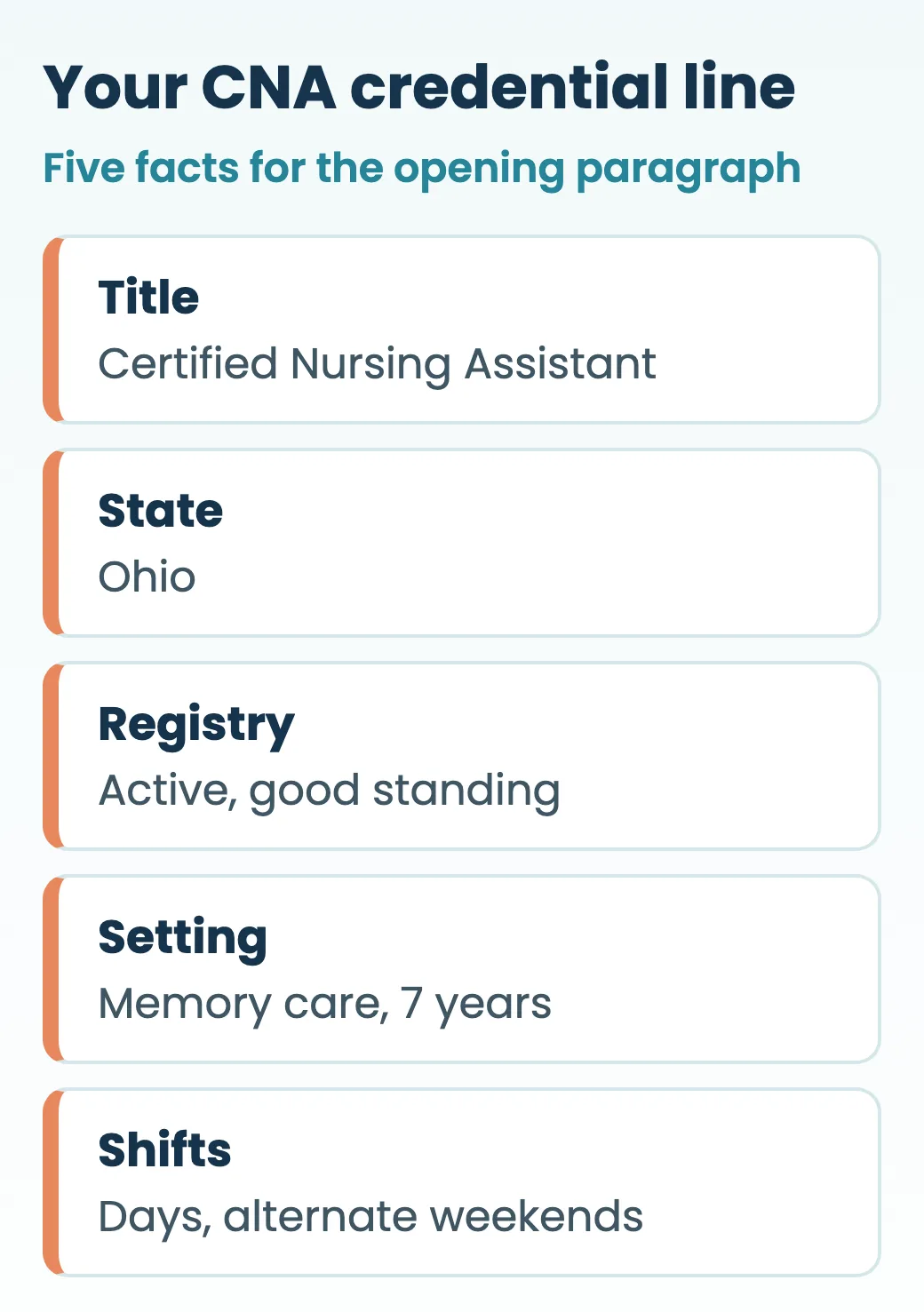
CNA cover letter checklist
Check these points before you send your letter to the facility.
Add your care settings and the posting, and StylingCV will draft a letter for you to edit.
Write my CNA letterChange your letter for nursing home, hospital or home health
Match your evidence to the setting. BLS lists nursing homes, hospitals, assisted living and home health among the places nursing assistants work, and each employer worries about something different. For Medicare-certified home health, an approved nurse aide program can qualify you when you're listed in good standing on your state registry.
Lead with continuity: resident load, dementia or rehab experience, and how you report small changes to the charge nurse.
Lead with pace and coordination: unit type, vital signs, patient transport and handoffs with nurses across a shift.
Lead with independence: following a care plan alone, documenting each visit, reliable travel and calling the supervising nurse early.
Lead with daily support and independence: help with bathing and dressing while residents keep as much of their routine as possible.
How to write a CNA cover letter with no experience
Build a no-experience CNA cover letter from your training. For nursing home aides, federal rules set a minimum of 75 training hours, including at least 16 hours of supervised practical work, and the competency evaluation combines a written or oral exam with a skills demonstration. Describe what you did in each.
Give the school, the finish date and whether you've passed both the knowledge and skills portions.
Pick tasks you performed under supervision, such as repositioning, feeding or walking with a gait belt.
Federal training covers communication, infection control, safety, independence and residents' rights before resident contact. Give an example of one.
Helping a relative, volunteering at a senior center or working as a companion all count when you label them accurately.
Write one concrete sentence about what draws you to hands-on care, then tie it to this facility's residents.
Enter your program, clinical tasks and the job posting in StylingCV to draft a CNA letter you can edit.
Create my letterSources
- BLS: nursing assistants and orderlies
- 42 CFR 483.152: nurse aide training programs
- 42 CFR 483.154: nurse aide competency evaluation
- 42 CFR 483.156: state nurse aide registry
- 42 CFR 483.35: nursing home staffing and nurse aides
- 42 CFR 484.80: home health aide qualifications
- 45 CFR 160.103: HIPAA definitions
CNA cover letter questions
How do I write a CNA cover letter with no experience?
Lead with your state-approved program, exam status and clinical hours. Describe two or three tasks you performed under supervision, add any related caregiving, and state your availability. Label anything pending so the employer knows exactly where you stand.
What should I say in a why I want to be a CNA paragraph?
Give one specific reason tied to hands-on care, such as helping a relative at home or a moment from clinicals. Then connect it to the facility's residents or unit. Two or three sentences are enough.
Should I put my CNA registry number on a cover letter?
Include it only if the application asks for it. Stating your state and good standing is usually enough for the letter, and the employer can confirm your status through the state registry.
Can I apply for CNA jobs before passing the state exam?
Often, yes, if you state your status clearly. Federal rules limit this: a nursing home can use a full-time trainee in a state-approved program for up to four months, and temporary or per diem aides must already be competent. Check your state's rules and the posting.
Do I need a cover letter with my CNA resume?
Send one when the posting allows it. The letter can explain your setting, shifts and registry status in a way a resume can't, and it helps when you're new or changing care settings.
How long should a CNA cover letter be?
Keep it to one page, about 150 to 230 words across three or four short paragraphs. Put your credential and availability in the opening lines.
More for your healthcare application
- resume templates to match your CNA letter
- cover letter examples for more jobs
- nurse cover letter examples
Turn your care experience into a CNA letter
Create your CNA letter in StylingCV, add your state and registry status, and tailor it to the facility before you apply.